

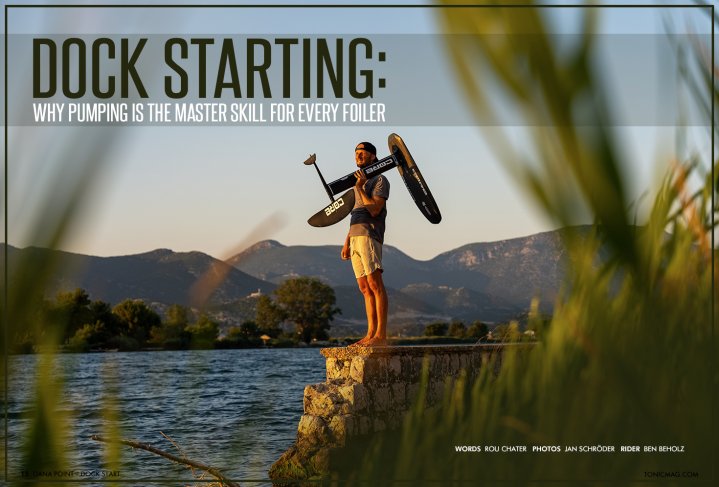
Dock starting may be one of the hardest things to do on a foil, but it's also arguably the best skill you can learn to improve all your foiling disciplines. The art of a good pump is the most essential and transferable skill in our sport. Rou Chater sat down with Ben Beholz on The Foil Pod recently to talk about the highs and lows of earning and the importance of cracking it.
Dock starting may be one of the hardest things to do on a foil, but it's also arguably the best skill you can learn to improve all your foiling disciplines. The art of a good pump is the most essential and transferable skill in our sport. Rou Chater sat down with Ben Beholz on The Foil Pod recently to talk about the highs and lows of earning and the importance of cracking it.
If you’ve been around foiling for any length of time, you’ll have noticed a pattern. The riders who really seem to “get it” across every discipline – wing, prone, downwind, kite – are almost always the ones who can pump properly. Not just a couple of desperate shuffles to save a botched gybe, but real, sustained, controlled pumping. The kind of pumping that lets you link bumps, flag out for longer and keep the foil alive when physics says you’re done.
At some point in your foiling journey, you realise that pumping isn’t an add-on skill. It’s the foundation. As Core team rider and YouTuber Ben Beholz put it when we spoke for The Foil Pod, “If you can pump foil and dock start, you really understand the foil. Then you really know when it stalls, how to keep it going, how long you can glide.” Once you’ve felt all of that through your legs with no wing, no wave and no engine to help, every other foiling discipline starts to become easier.
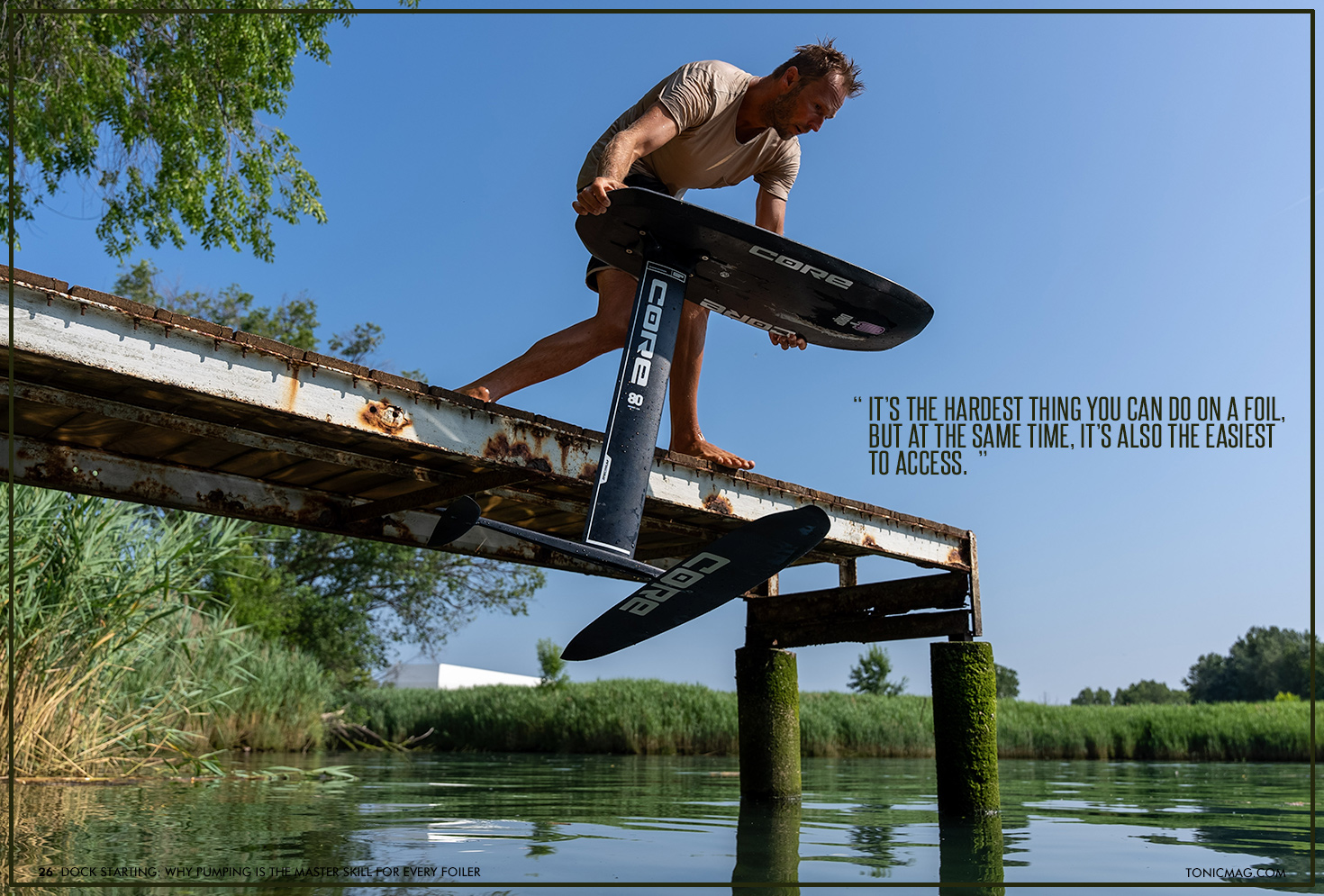
Dock starting has become the purest expression of that learning curve. In many ways, it’s the hardest thing you can do on a foil, but at the same time, it’s also the easiest to access. You don’t need wind or swell or a boat, and there is no waiting on a forecast. You just need a dock, a ladder or even a rock, a foil set-up and a slightly worrying level of determination.
The Hardest Easy Thing in Foiling
Let’s be honest: dock starting feels ridiculous at first. The idea that you’re going to sprint down a dock, jump onto a board that’s floating in space on a wing the width of a well-proportioned coffee table, miss every cleat and obstacle on the way in, and somehow not die, sounds optimistic at best.
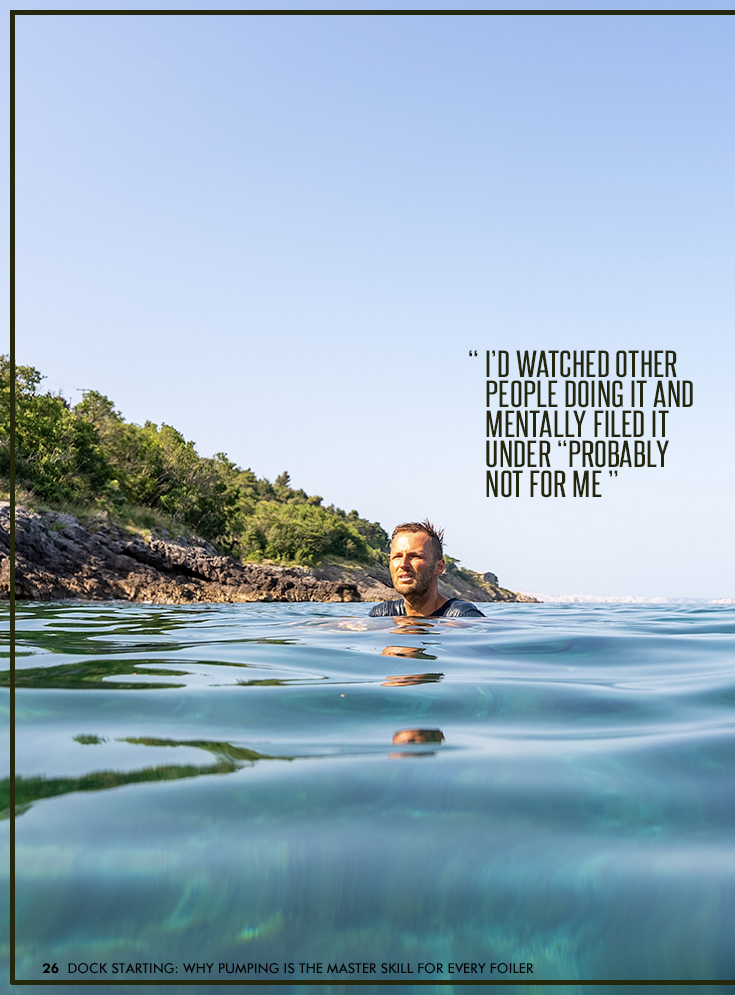
I remember my own first attempts vividly. I’d watched other people doing it and mentally filed it under “probably not for me”. Then at a UK event, I watched our very own Jack Galloway stepping effortlessly off a ladder and cruising around like it was no big deal. Jack’s an incredible downwind and pump foiler, the sort of guy who makes everything look easy, but when I asked him what he thought about me learning, the answer was brutally honest. I was probably a bit old, probably not quite fit enough, and it was going to be really tough. For a while, that was all the excuse I needed.
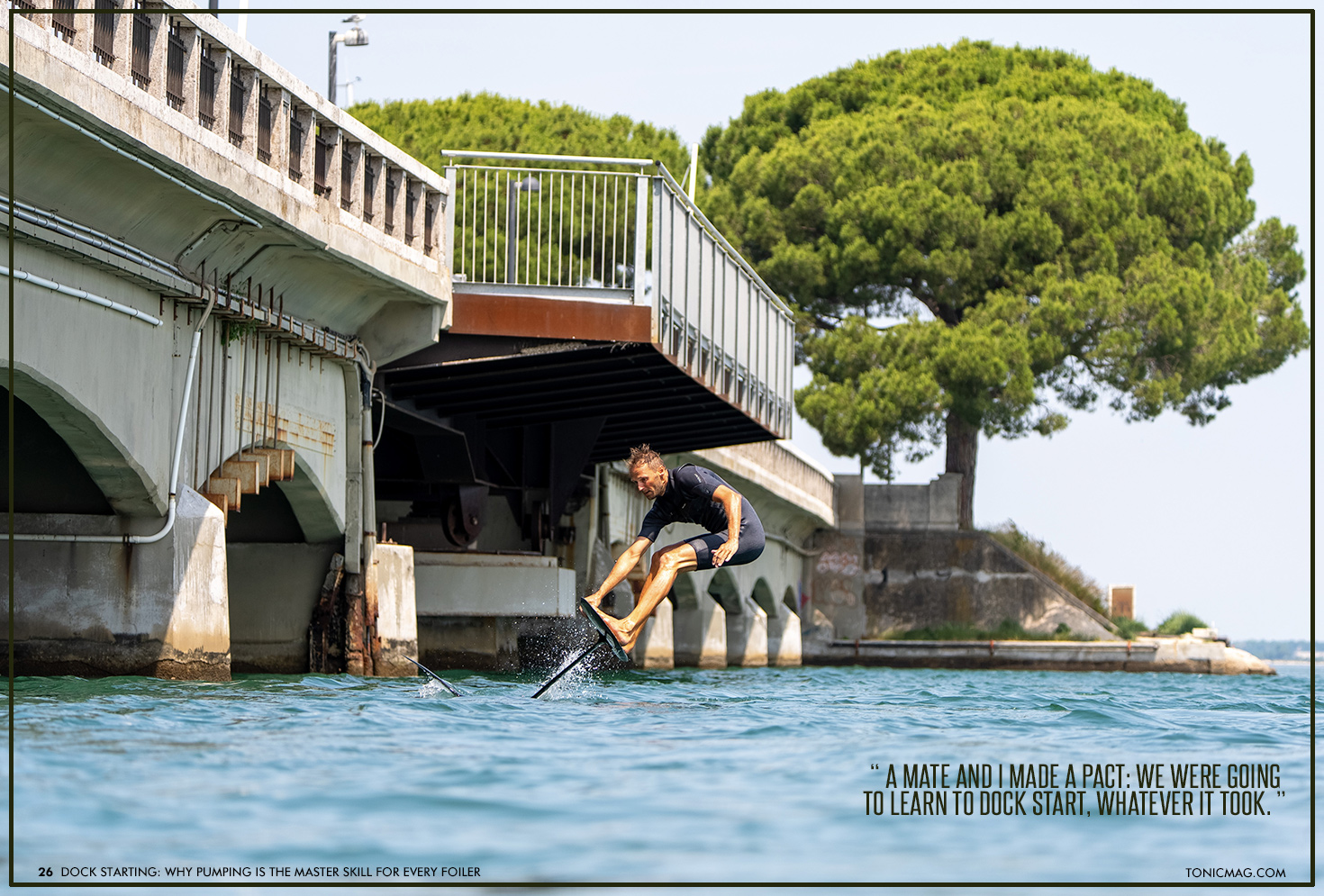
Eventually, the fear of being left behind outweighed the fear of smashing into a pontoon. A mate and I made a pact: we were going to learn to dock start, whatever it took. We found a suitable dock, bolted our biggest foils to some old kite foil boards and started throwing ourselves at it. On my first jump I thought, “This is horrific and not for me,” but Oli, my mate, encouraged me to keep at it and, honestly, if it wasn’t for him, I’d have given up after my third go. We persevered and eventually started getting the odd landing and a little glide.
It’s insanely addictive – or maybe I just have an addictive personality. My partner could not understand what was happening to me. Four hours a day, every day for a week, coming home exhausted, battered and bruised, just to do it again the next morning. When you’re deep in that phase, it’s hard to explain to anyone who isn’t there with you what all the fuss is about, but you’ll want to keep doing it over and over again so you can crack it.
Ben’s experience was similar, and he’s quick to stress that there’s no shortcut through this phase. “When I teach this to people, I always say it takes a thousand tries,” he told me. “Nobody gets around it. You just need to invest in it.” Some days you feel like you’ve cracked it; the next day you’re back to square one, falling on your face and wondering what changed. The trick, he says, is not to treat it like a magical breakthrough moment, but like training. “See it as a workout. Go to the water every day for 20 or 30 minutes before or after work and make it a routine. Don’t expect it to happen this session. After a week or ten days, though, you will foil.”
What makes dock starting both horrible and brilliant is that it removes every safety net. There’s no energy coming from anywhere except you. No wing to drag you through errors, no wave face doing half the work, no parawing to lean against. It’s just the speed from your start, your legs, your timing and your foil, which is exactly why it’s such a powerful teacher.
How Dock Starting Transforms Your Foiling
Once you claw your way through that first successful lap – and you will, if you stick at it – something shifts. You start to feel the foil in a way that’s hard to access in other disciplines. The subtle moment just before a stall, the precise pressure change that keeps it flying, the quiet, efficient glide phases where you’re doing very little and the foil is doing everything. You get an almost subconscious sense of how deep on the mast you are, constantly trying to stay high, and how hard you can load it without killing the lift.
Ben summed it up nicely when he contrasted it with kite foiling. “With kite foiling, it’s just not the same knowledge I need for my foil because the kite pulls and there’s so much power. In pump foiling, you need to generate everything out of your body. There’s nothing. Just a bit of current or wind can already be deadly for the pumping motion.” If you can keep a foil flying in that environment, doing a couple of recovery pumps out of a wing-foil gybe suddenly feels trivial.
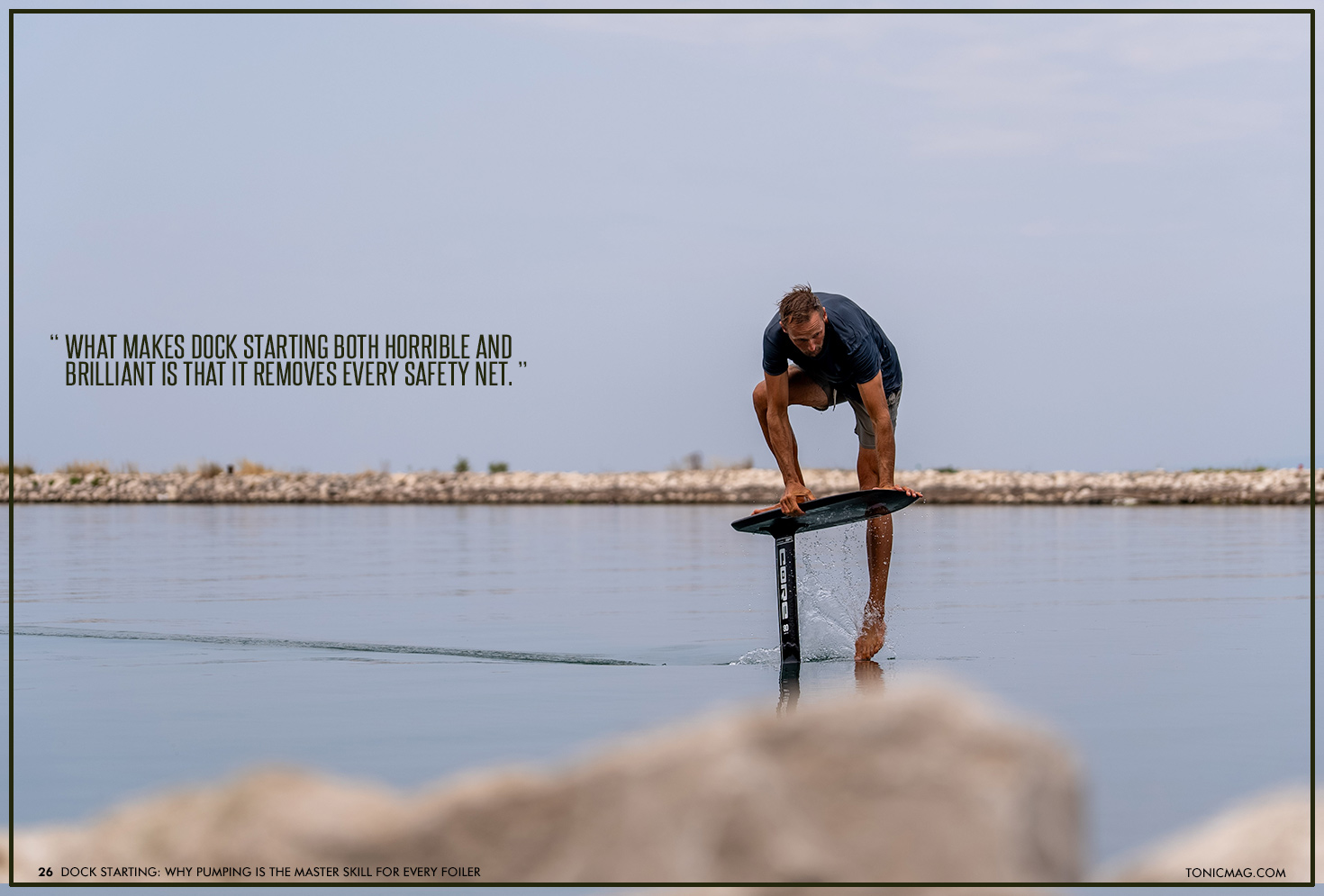
From my side, the difference it made across all my foiling was huge. Wing foiling became easier; gybes and tacks were simple, as I understood the glide and pump so much better, and on downwind runs I barely needed the wing at all. Linking bumps was easier. Prone sessions, especially on marginal days, stopped being about catching one wave and a long paddle back; I was starting to pump back out and link waves too. Downwind runs felt more connected because I could use pumping to bridge the gaps between bumps rather than giving up when the energy dropped. Everything tightened up and, perhaps most importantly, my confidence grew. Once you know that you can keep the foil going under your own steam, you ride differently.
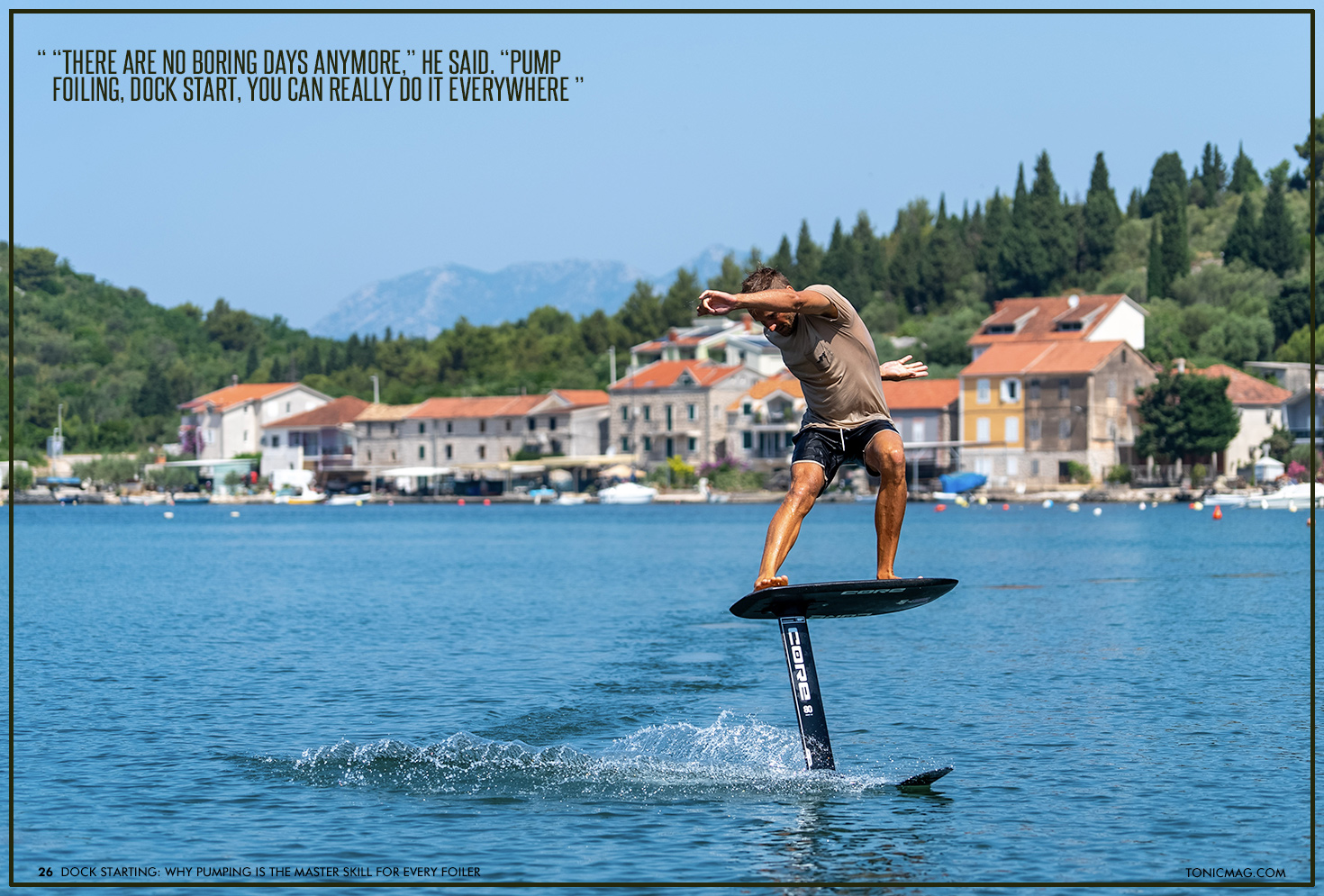
Ben sees that too, and he’s convinced that more riders should give dock starting a chance, even if it frightens them a little. “There are no boring days anymore,” he said. “Pump foiling, dock start, you can really do it everywhere. A stone is enough or a beach, if you can do a beach start. The freedom that comes with it is the cool thing.”
I’d echo that sentiment too. EVERY DAY is a foil day. Since I learned to dock start a few years ago, I have barely ridden my mountain bike; I can be in the ocean no matter the forecast. More time on foil just means you improve across all aspects of foiling. It is perhaps the most transferable skill within our sport. Good pumping technique is needed in every discipline.
Why Equipment Choice Matters More Than You Think
The other big lesson I learned early on is that not all foils are created equal when it comes to dock starting. I began on an F-One Phantom that was brilliant with a wing and in the surf but absolutely unforgiving off the dock. Every time I jumped on it, the foil wanted to dart left or right, and any slight mistake was punished instantly. Oli, my dock-starting mate, meanwhile, was on an Axis 1150 – at the time, pretty much the gold standard for learning to dock start, and still a good foil with which to learn even to this day – and while he definitely had better technique, he also had more help from his gear.
The penny dropped when another friend turned up, jumped on my set-up and struggled every time, then hopped on the 1150 and started making it look possible. I eventually managed a few short glides on the Axis, phoned Tom at the UK distributor on the drive home and basically begged for an 1150. The difference really was that stark.
Ben went through the same evolution. Early on, he was using relatively small wings that demanded a huge run-up and brutal effort just to get flying. “I needed much more speed,” he remembers. “With the new pump foils, you can just use a standing start, jump on it, and it gets going. The foils were too small back then.”
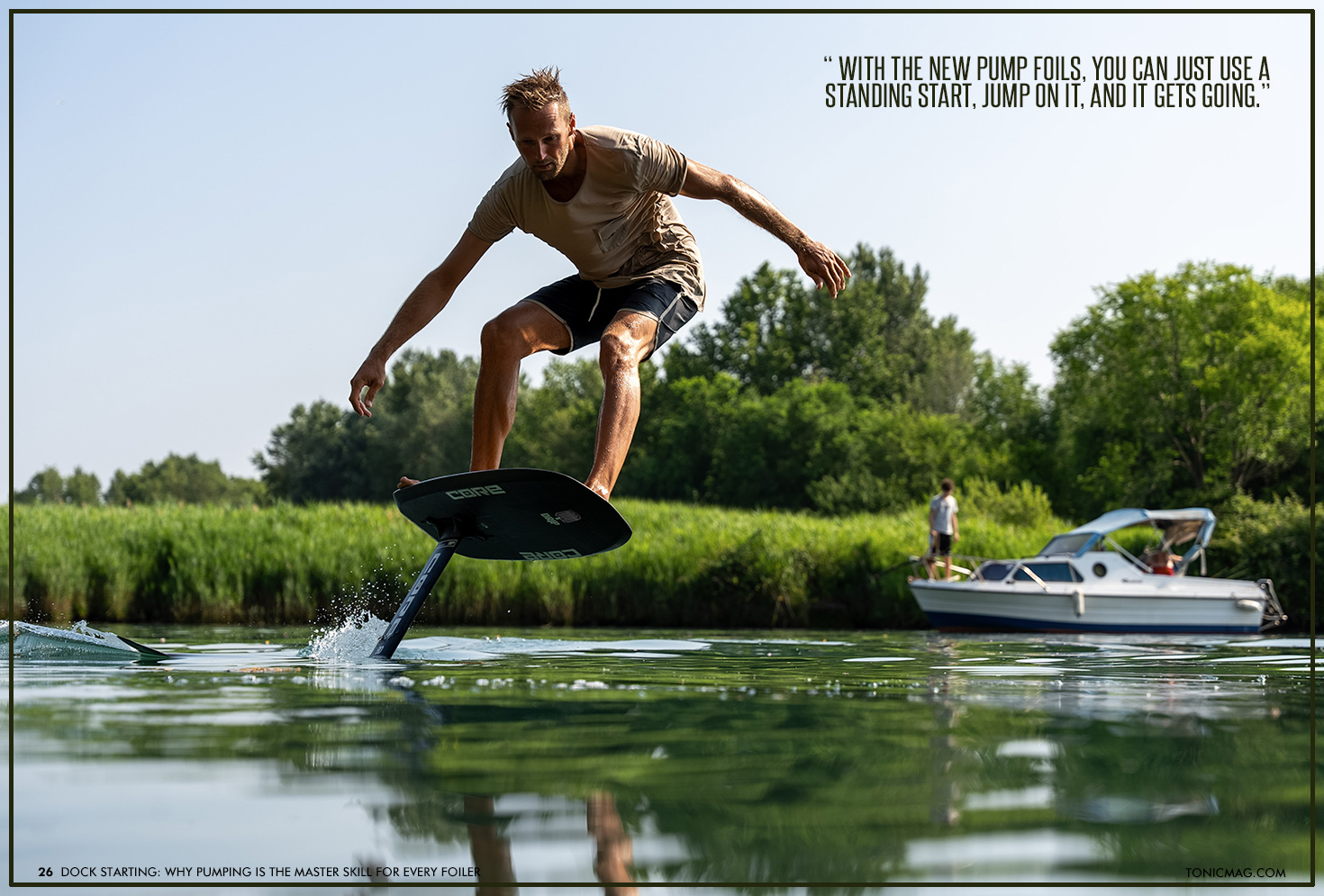
Modern pump and dock-start foils have changed the game. Higher aspect ratios, refined profiles and dedicated stabilisers have made it much more realistic for “normal” humans to learn. Core’s arrival in this space with their Pulse front wing and Drip board is a good illustration of how seriously the bigger brands are starting to take it.
The Core Pulse and Drip: Making Dock Starts More Accessible
Core has never been known for racing to market with half-baked ideas. They were relatively late to kite foiling and wing foiling, preferring to watch the early chaos, learn from everyone else’s mistakes and then release polished, durable products. Pump foiling is the first time they’ve moved early, and you can feel that both the Pulse foil and Drip board have come from real-world use rather than a marketing brainstorm.
Part of that is down to Ben’s enthusiasm. Based on his description, he badgered them for long enough that people inside the brand started pump foiling themselves, especially around the lakes of Germany and Switzerland where the sport has quietly grown into a scene of its own. Once that happened, development became an obvious next step.
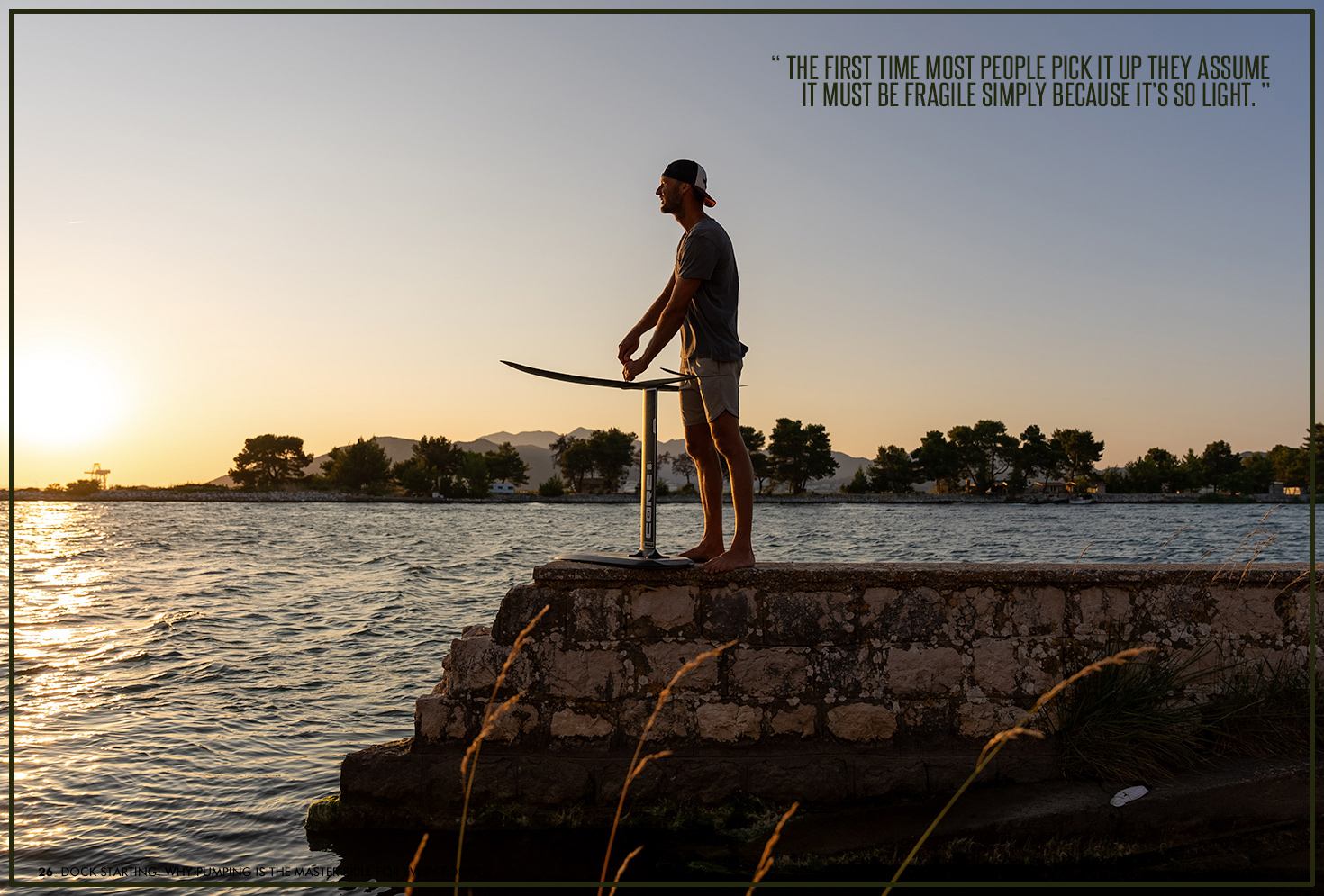
The Pulse front wing is deliberately pitched as a beginner-to-mid-level solution. “It’s not a high-performance foil to pump four or five hours, but also it’s not a total beginner foil which is slow,” Ben explained. “It’s really something in the middle.” In practice, that means enough low-end lift and stability to help you off the dock, but enough speed and glide that you won’t grow out of it after a month. Core already had a modular foil system in place for their CFS foils, so the Pulse slots into that ecosystem. If you already own a Core mast and fuselage, you can bolt the Pulse and matching stabiliser straight on.
Ben likes to pair the Pulse with a longer fuselage and a larger tail when he’s teaching or setting people up to learn. A longer fuse calms the pitch and makes the whole system feel more forgiving, buying you just enough time to correct mistakes before the foil stalls. “Some people say as short as possible,” he said, “but especially in the beginning, when you need to develop the feeling of where to jump on, how to balance, how much weight on the back foot or the front foot, I think it really makes sense to have a long fuselage. It’s much more forgiving.” On the stabiliser side, he often runs the 300, which adds extra low-speed lift and makes getting up and staying up less demanding.
The Drip board completes the picture. At 95 cm, it looks tiny on land, and the first time most people pick it up they assume it must be fragile simply because it’s so light. “Everyone I gave it to was like, this board will never last,” Ben laughed. “But the crazy thing is, it lasts. It’s very stiff, it’s very strong, and I didn’t break a single one.” That low weight and stiffness are exactly what you want for pump foiling. Any flex in the board robs you of energy, and any extra length in front of your front foot becomes swing weight that needs to be moved with every pump.
Ben noticed the difference clearly when he was helping a friend in Greece who only had a much longer kite foil board. “It’s hard to imagine, but it takes a lot of energy,” he said. “If you just have like 20 centimetres of board in front of your foot, it swings. Everything that swings or any weight that goes into any direction where you don’t want it, it’s distracting and takes energy.” The Drip, being compact and stiff, minimises that wasted movement.
Interestingly, the board is not a one-trick pony. Ben has also used it for kite foiling with smaller wings, and it works well enough in that role, just as Core’s SLC kite foil board in 115 cm doubles nicely as a pump board if you don’t want a dedicated set-up. But if your focus is dock starting and pumping, the Drip is very clearly optimised for that use case.
Turning Up Every Day
The story that runs through all of this – from inland lakes in Germany and Switzerland to docks in Wales and beaches in Greece – isn’t really about equipment, though. The gear helps. Modern pump foils like the Pulse and compact boards like the Drip make dock starting less punishing and more achievable. But the deciding factor is still whether you’re willing to turn up, day after day, for that 20–30 minute window and throw yourself at it.
Dock starting is not a sport for people who need instant validation. The first few sessions are a mess. You will scare yourself. You will get bruised. You will seriously consider giving up. But somewhere along the way, you’ll suddenly make it off the end of the dock. Then, eventually, you’ll make it back. Then you’ll start to explore. And once it clicks, as Ben says, it stays. Even if your docks get taken out for winter, like ours do in Pembrokeshire, you come back in summer, feel strangely nervous on the first jump, and then, a couple of attempts later, it all returns.
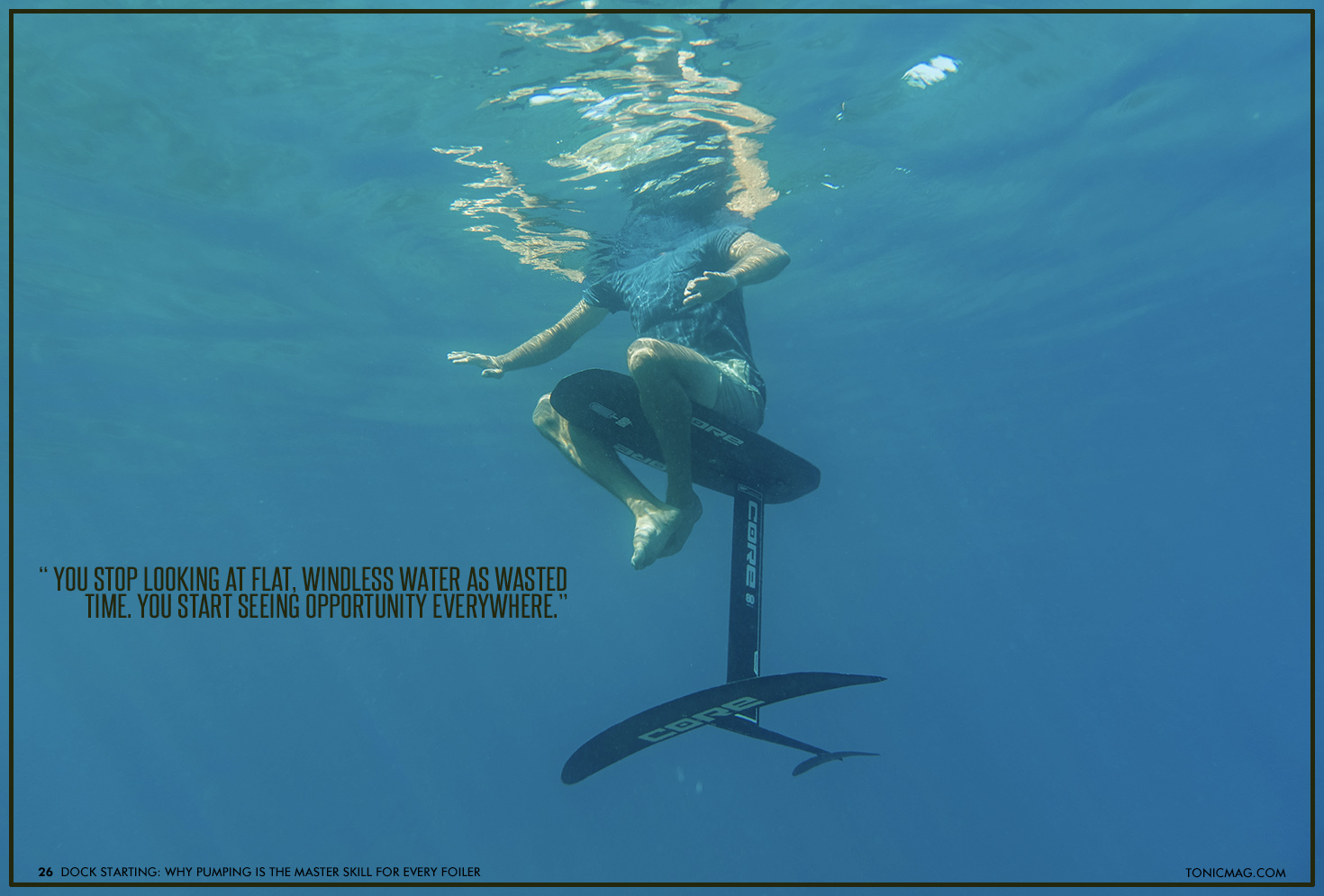
For me, that’s the magic of it. Dock starting forces you to earn your foiling in the most honest possible way, and in doing so it quietly rewires every other part of your riding. You will get fitter, more confident and far more in tune with your gear. You stop looking at flat, windless water as wasted time. You start seeing opportunity everywhere.
If you’re already deep into winging, prone or downwind and you’ve been quietly avoiding dock starting because it looks too hard, consider this your nudge. Treat it like the gym. Accept that you’re going to look rubbish for a while. Choose gear that’s actually designed to help you. And keep going long enough to get through those first couple of hundred jumps until you see that glimmer of success and get addicted.
On the other side of that, there’s a version of your foiling that’s lighter, freer and far more connected – and a sport that suddenly works on almost every day, in almost every place, with almost no excuses.
By Tonic Mag
