


Tech Focus - Ride Engine Air Box Mini
Issue 26 / Mon 15th Dec, 2025
For years, pumping up a wing, kite or SUP has been one of those unavoidable rituals that quietly steals time and energy. Manual pumps have improved incrementally, but the basic experience has remained the same: bending over, pushing hard against resistance, checking pressure by eye with a far-from-accurate analogue gauge, and the only real positive is the warm-up. The Air Box Mini from Ride Engine is set to change all that!
The Pump That Brings Wing and Kite Inflation Up to Date
For years, pumping up a wing, kite or SUP has been one of those unavoidable rituals that quietly steals time and energy. Manual pumps have improved incrementally, but the basic experience has remained the same: bending over, pushing hard against resistance, checking pressure by eye with a far-from-accurate analogue gauge, and the only real positive is the warm-up.
Modern wings need pretty specific pressures in order to work correctly. The entire structure of the wing is dictated by the PSI inside the leading edge and the strut, and getting it wrong vastly affects performance. Not enough air and the wing won’t have power, will fold and crease, and the low end will be severely affected, as you won’t be able to pump it. Too much air causes the wing to distort from its intended shape. There is a reason why manufacturers specify certain PSI values on their wings, and it is prudent to stick to them as closely as possible to ensure you are riding the wing as the designers meant it to be ridden.

Ride Engine’s new Air Box Mini aims to change that dynamic entirely. Compact, fast and fully automated, it delivers the kind of upgrade that feels overdue in a sport where almost every other component has gone through a technological revolution.
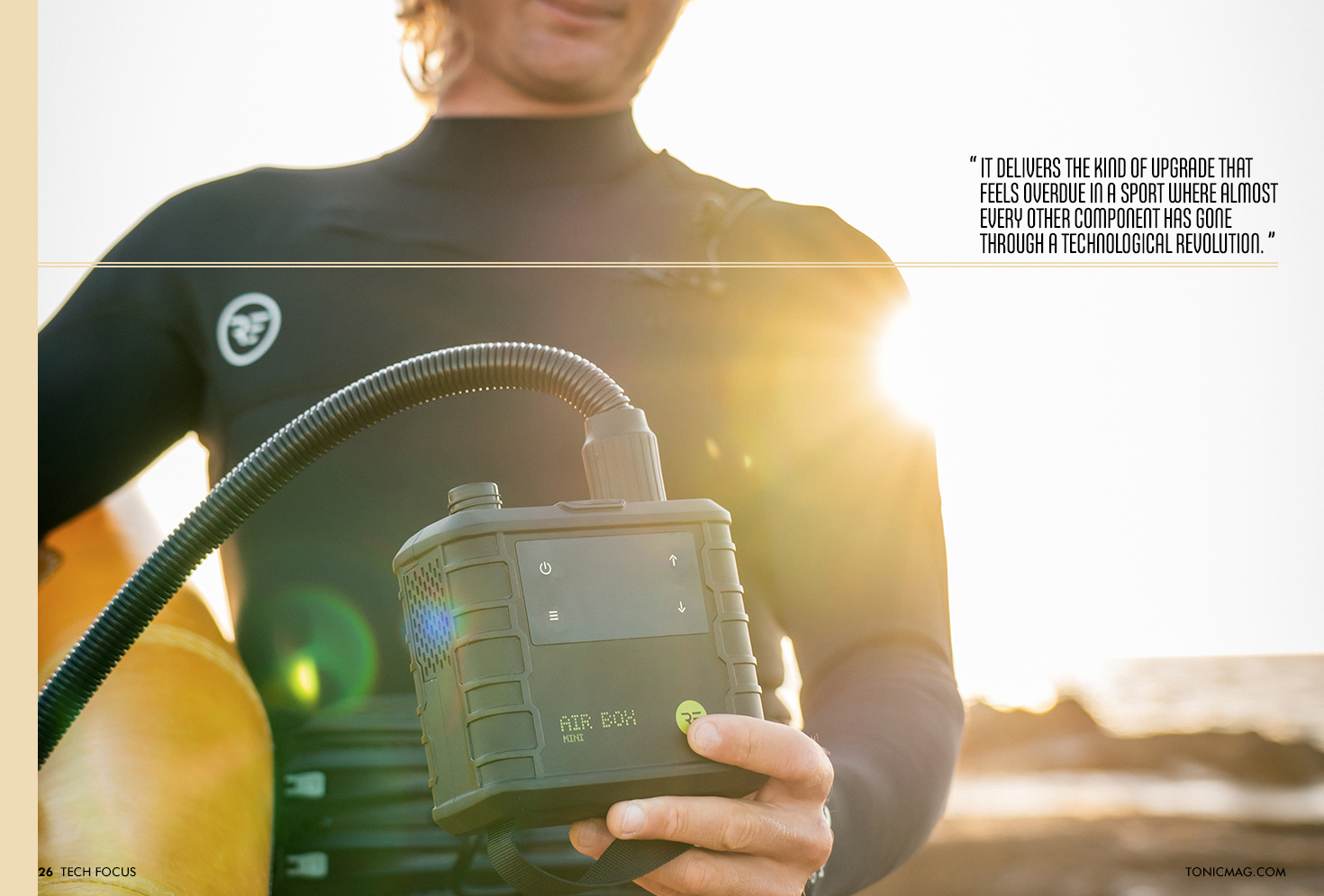
The Air Box Mini enters the market off the back of Ride Engine’s original electric pump, but it isn’t a small revision. It is significantly more compact, far easier to pack, and thanks to new brushless motors, it inflates faster and more efficiently. The footprint is roughly a third smaller than the previous model, making it a realistic everyday carry for anyone heading to the beach. Overseas travellers, van-based riders and anyone who likes to keep their setup streamlined will immediately appreciate the reduction in bulk.
Performance is where the improvements really stand out. The brushless dual-stage motor system delivers high-volume airflow at the start, then automatically transitions into a high-pressure stage to top your wing or kite off precisely. You simply set your desired PSI, press go, and walk away. Once the target pressure is reached, the pump shuts itself off. The result is consistent inflation every session, without the guesswork that creeps in when relying on an analogue gauge or a subjective feel for firmness.
Battery life has also seen a notable step forward. The Air Box Mini’s 4500 mAh lithium-ion battery can inflate multiple wings or kites on a single charge, or up to several SUPs, depending on volume. For riders who switch sizes mid-session, or for those who spend long days on the beach, this offers practical freedom that traditional pumps simply cannot. There is also a reverse-charging feature, allowing the pump to double as a power bank in a pinch. While it is not something you will use every day, it does reinforce how this device fits into the modern, multi-gadget setup we all live in.
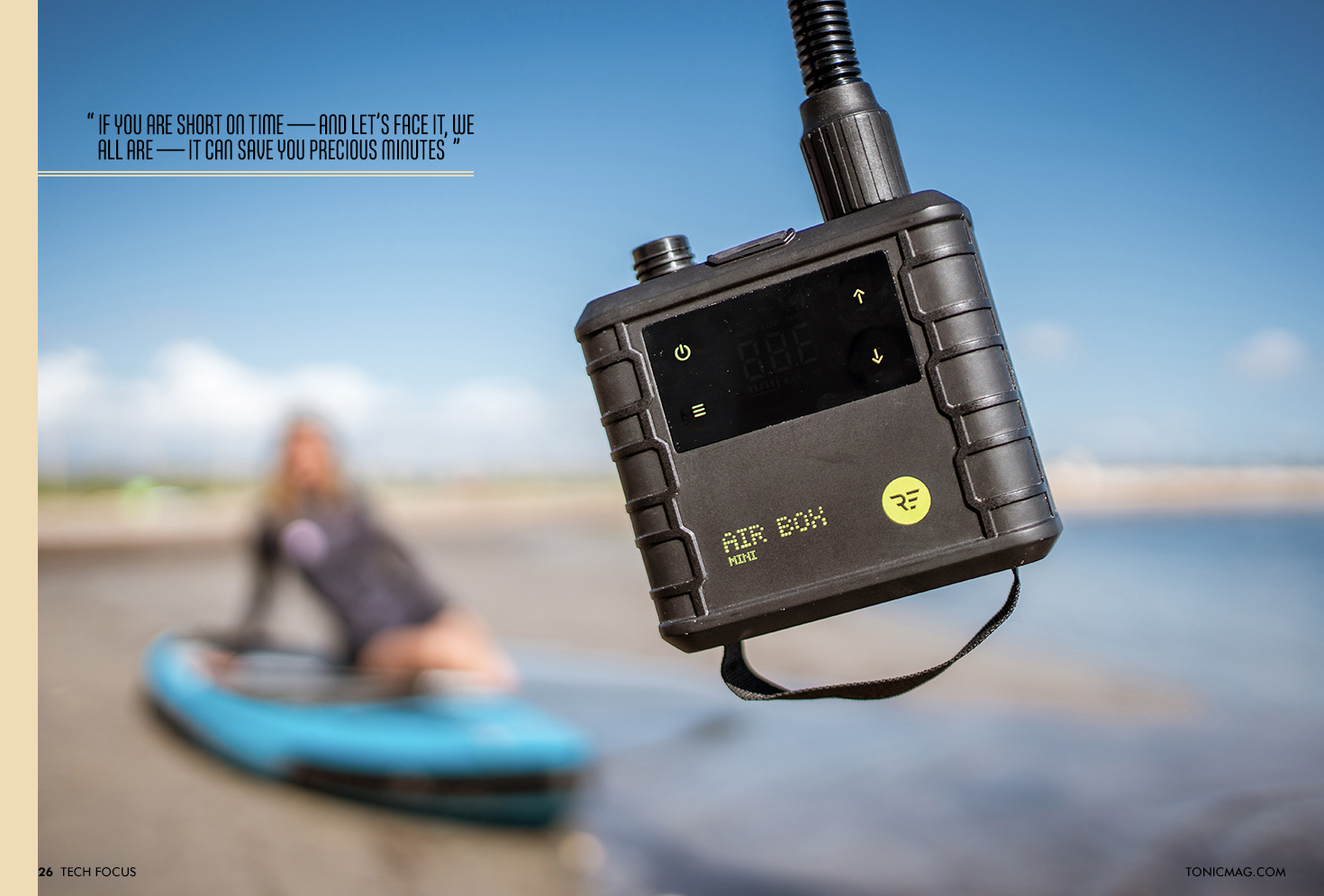
But the biggest real-world advantage is not actually the pump itself; it is the time it hands back to the rider. With a manual pump, inflating your wing doesn’t take long, but if you are short on time — and let’s face it, we all are — it can save you precious minutes. With the Air Box Mini, you press start, then step away. You can assemble your foil mast and fuselage, attach your stabiliser, fit your front wing, and double-check everything while the pump does the hard work for you. You can sort your wetsuit, get your boots on, or run through a couple of mobility exercises before you hit the water. All while the Air Box Mini is busy pumping your wing for you.
This is particularly valuable in wing-foiling, where rigging the foil setup is often more time-consuming than preparing the wing. By the time you’ve tightened the final bolts, your wing is typically ready to go. More than that, you get the perfect amount of pressure in your wing every time, meaning you will get the maximum amount of performance out of it.
This is perhaps the most underrated performance element here: precise and repeatable pressure. Manufacturers design wings to fly optimally at specific PSI ranges, and small variations can have a big impact on stiffness, responsiveness and depower. A wing that is 1 PSI low can feel spongy and less efficient. One that is slightly over-inflated can lose its shape as it tries to straighten itself out, plus you are putting additional pressure on all the seams. The Air Box Mini’s auto shut-off ensures that each inflation is exactly on spec, every time.
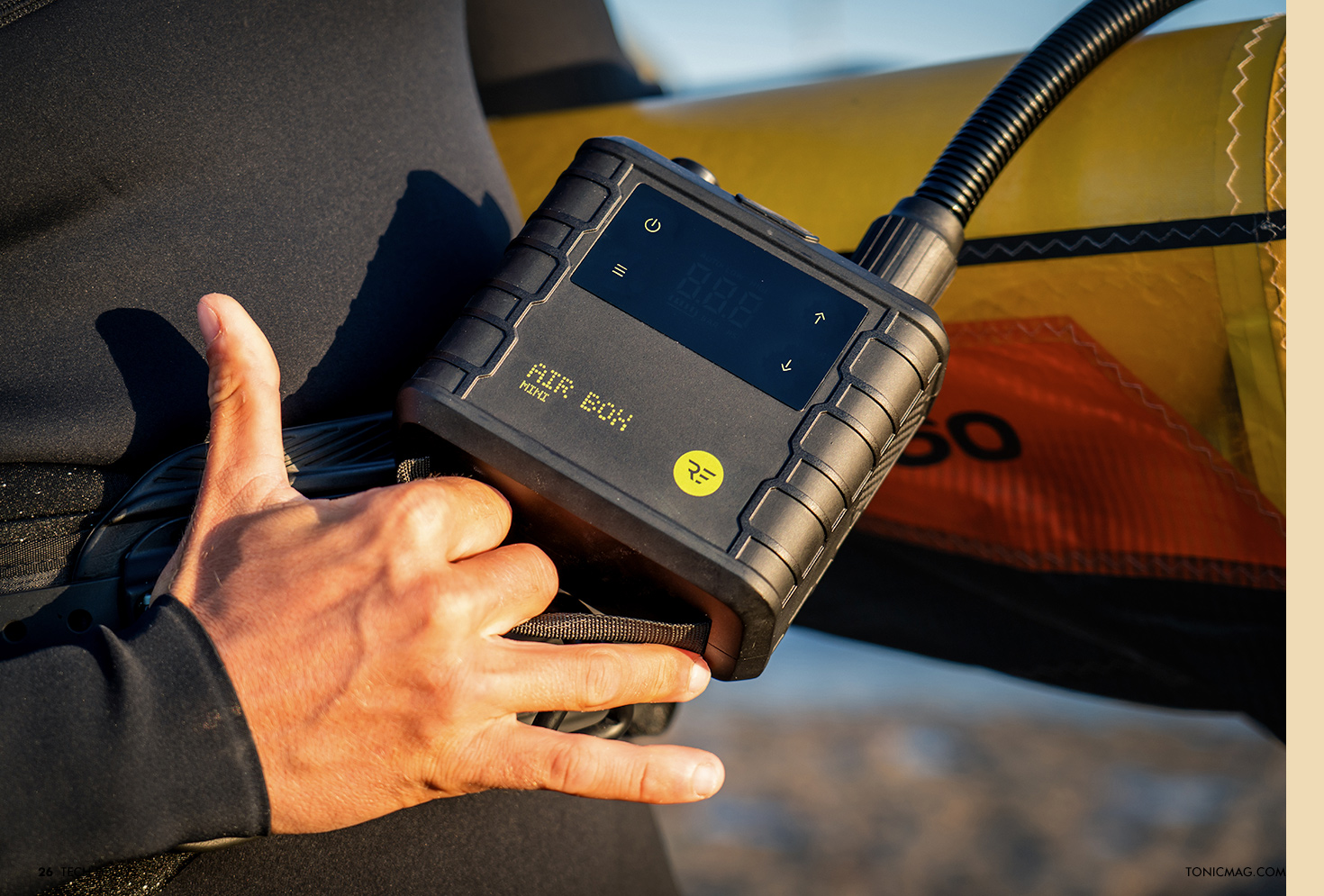
Of course, electric pumps are not entirely without limitations. They need to be charged, and while they are robust, they are not designed to be exposed to water directly. Many riders still carry a manual pump as a backup, especially for remote locations or long trips. But as a primary inflation tool, the Air Box Mini is compelling not simply because it does the job, but because it changes the texture of the setup experience.
Wing-foiling continues to evolve quickly, with innovations in boards, foils and materials arriving almost seasonally. Yet the pump, the device that literally brings our gear to life, has remained an afterthought. The Air Box Mini signals a shift. It is not just a convenience gadget; it is a meaningful upgrade in efficiency and consistency of pressures. If getting on the water faster, with less effort and greater accuracy, is a priority, this little pump deserves a place in your kit.

Videos


By Tonic Mag
