

The Union Effect
Issue 26 / Mon 15th Dec, 2025
Rou Chater sits down with Jon Modica to get technical on The Foil Pod. Check out the full episode on Spotify or wherever you get your podcasts. The Union Connection System was one of the most talked-about designs at the recent AWSI event in the US, and it is now available to the public, too. Read on to learn the story behind this new direction for the brand and their foils.
How Cabrinha Re-Engineered Their Hydrofoil Range From the Connection Up
Rou Chater sits down with Jon Modica to get technical on The Foil Pod. Check out the full episode on Spotify or wherever you get your podcasts. The Union Connection System was one of the most talked-about designs at the recent AWSI event in the US, and it is now available to the public, too. Read on to learn the story behind this new direction for the brand and their foils.
When Cabrinha set out to build its next-generation foil system, the team didn’t want to settle for an upgrade. They wanted a reboot — the kind of rethink that scraps the assumptions of the previous platform and rebuilds the entire architecture around hydrodynamic efficiency, stiffness, and pure, uncompromised feel. The result is the Union System: a connection standard and wing platform that rides smoother, glides further, and turns more naturally than anything Cabrinha has produced before. And for the riders who’ve tested it, there’s a common refrain — this foil doesn’t feel like a new model; it feels like a new category.
At the centre of the project is Jon Modica, Cabrinha’s chairman and the unofficial fuel injector of its foil programme. Modica’s relationship with foiling runs deep; long before he owned the brand, he was racing ram-air kites on early Mike’s Lab foils and absorbing everything he could from the pioneers shaping the sport. That history isn’t a footnote; it’s the reason Cabrinha didn’t simply evolve the existing Fusion system. Jon’s passion led the charge for this bold new direction.
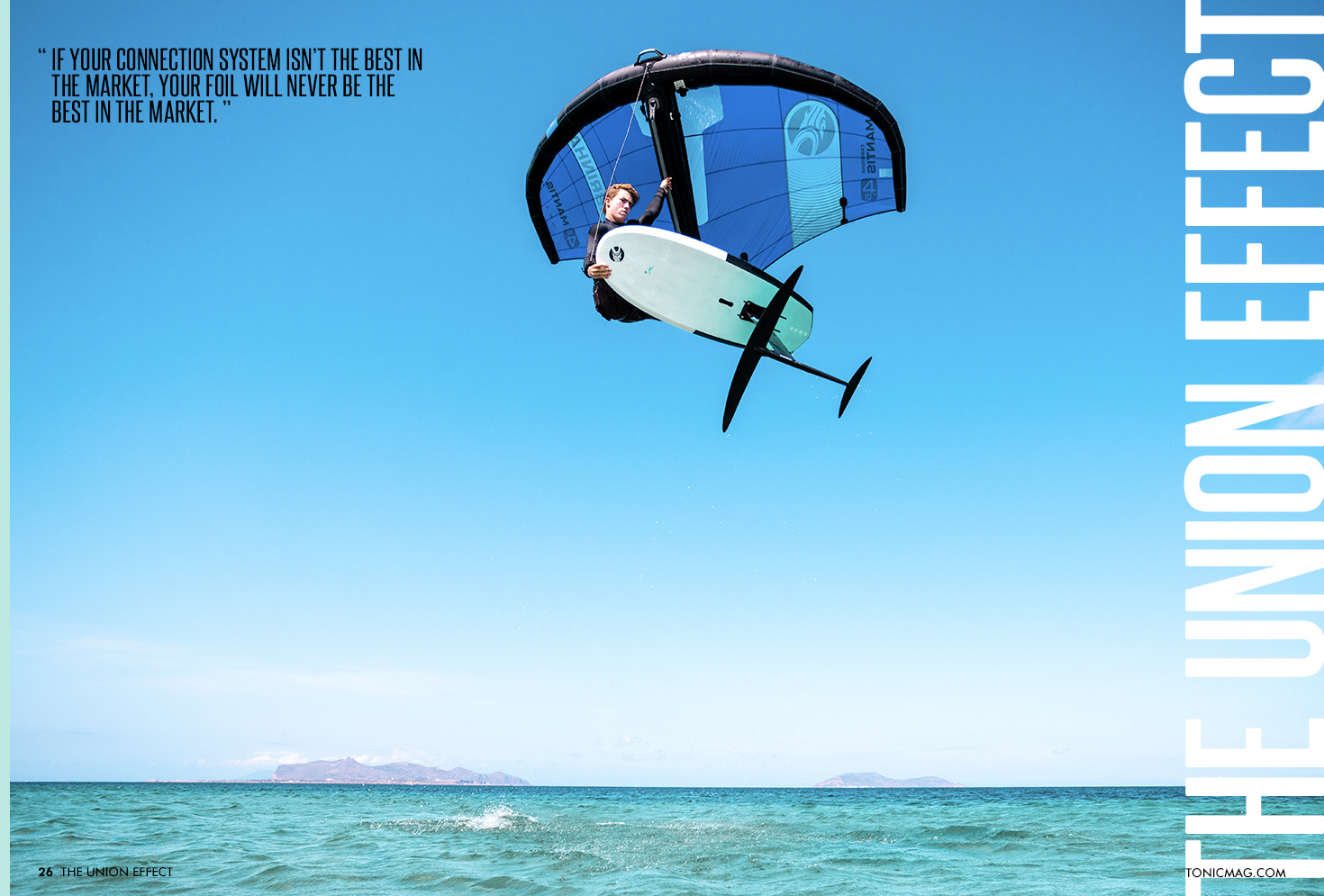
“We were limited by the connection,” Modica says plainly. “If your connection system isn’t the best in the market, your foil will never be the best in the market.” Season after season, Cabrinha’s designers could feel the ceiling getting lower. The wings improved. The masts improved. But the interface — the literal joint holding the system together — could only go so far. To break past that limit, Cabrinha would need to borrow from the best.
So Modica made the phone call no one expected him to make.
THE MIKE’S LAB MOMENT
The Mike’s Lab saddle system has long been the quiet north star of hydrofoil engineering. It’s the interface used on world-title-winning race foils, the geometry others imitate, the benchmark for stiffness and drag reduction. But the idea of a large consumer brand licensing it directly? That had never happened. Even Modica admits he was nervous.
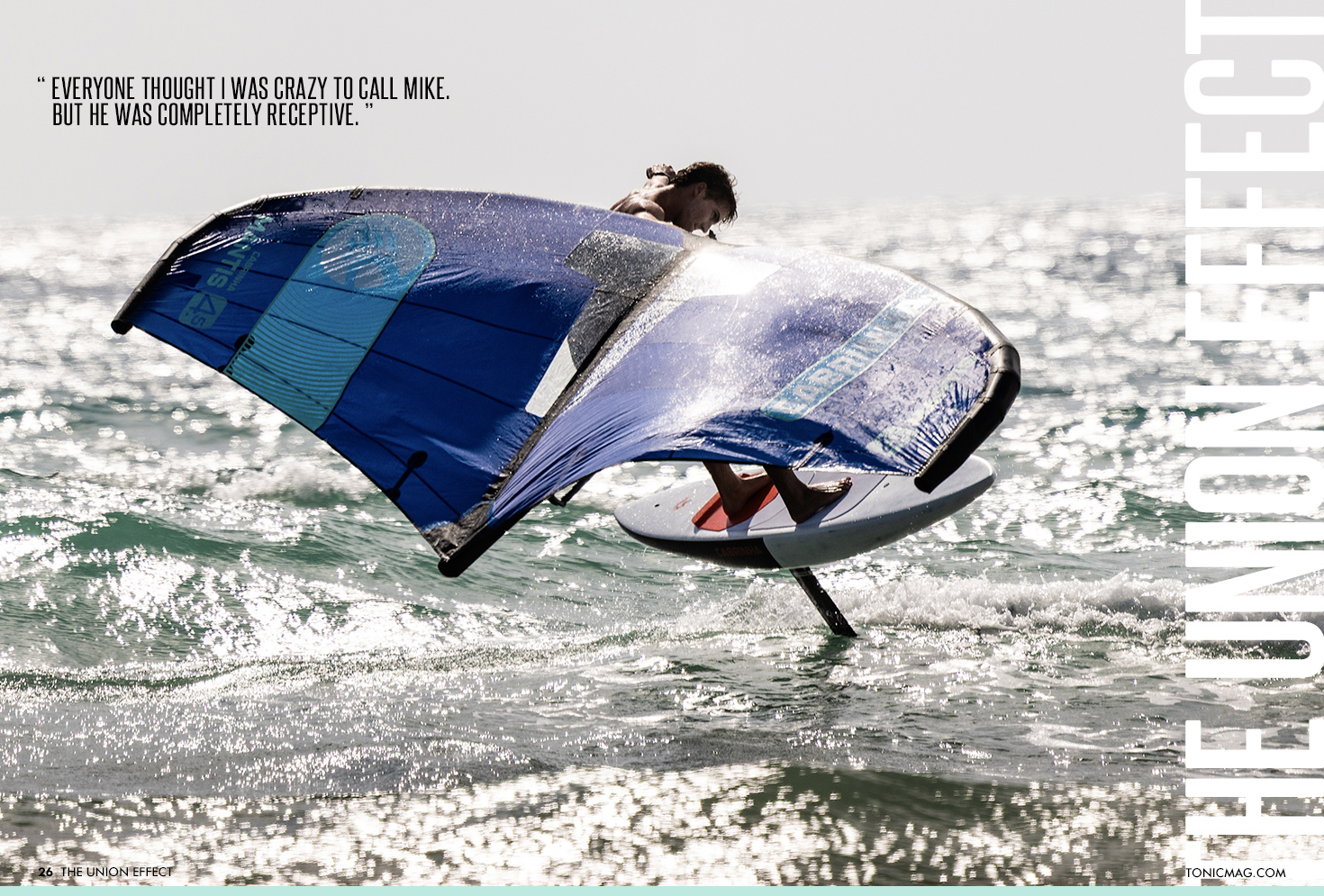
“Everyone thought I was crazy,” he recalls. But the conversation that followed overturned every assumption. Mike wasn’t dismissive; he was interested. He saw an opportunity to influence a broader market without sacrificing the integrity of his design. From that first conversation, collaboration became not only possible but essential.
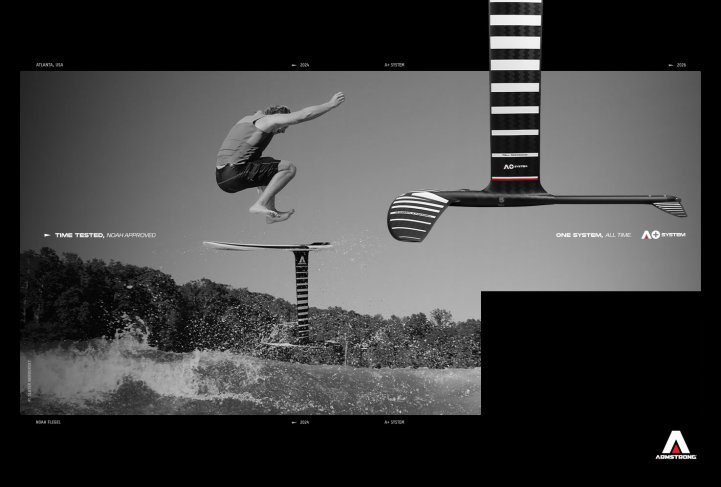
Mike and his long-time design partner Stefano joined Cabrinha’s engineering team to refine, adapt, and scale the geometry for a wider audience — a system for riders who aren’t just pushing 40 knots on a race course, but winging, prone-foiling, carving, and downwinding across an enormous performance spectrum, with much wider spans than those found on traditional kite race foils.
A CONNECTION BUILT AROUND FEEL
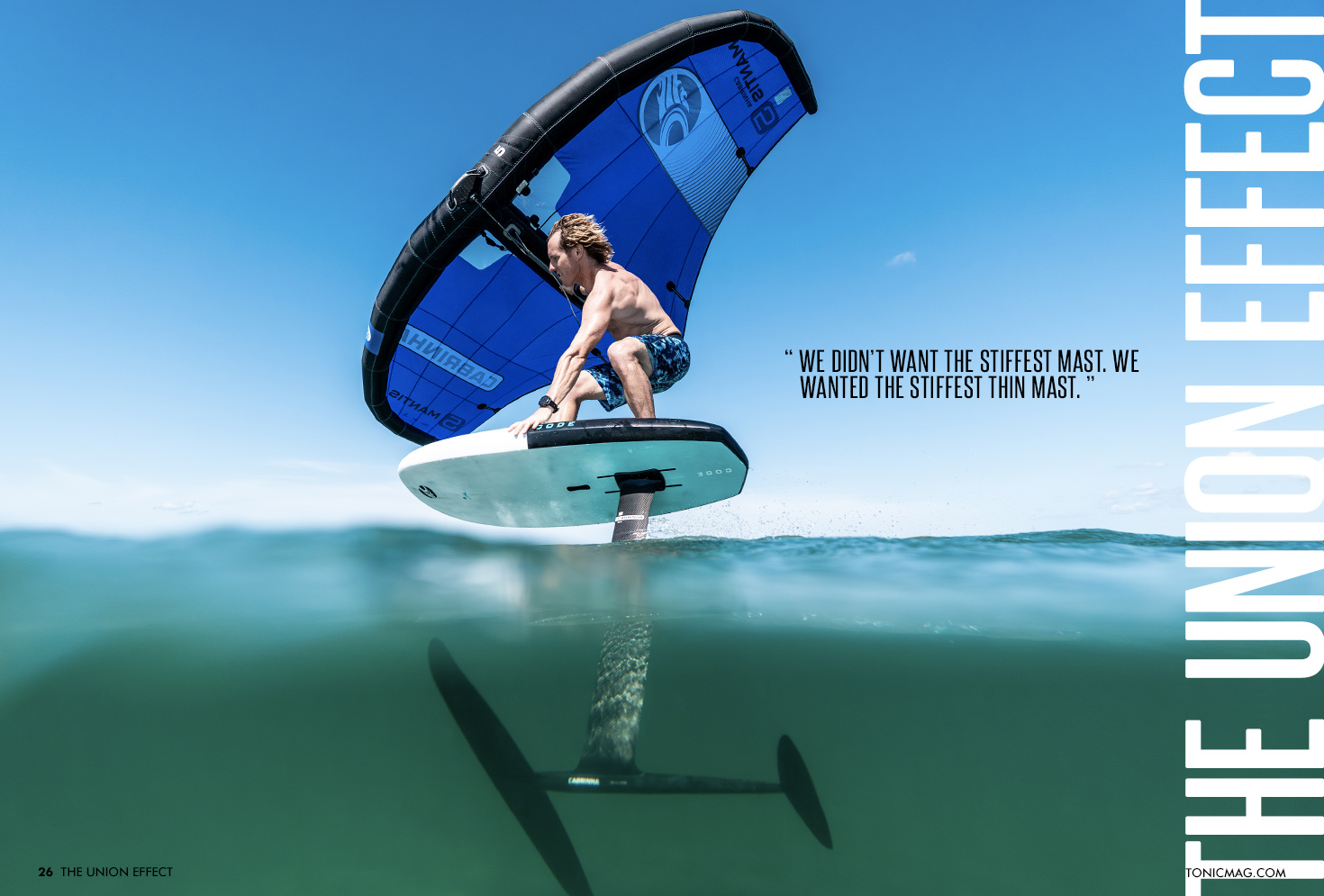
The Union connection isn’t an identical copy of the Mike’s Lab saddle. It’s a carefully adjusted evolution: slightly larger in diameter, subtly reinforced, and built for durability across disciplines. That tiny increase in diameter — just over a millimetre — transformed the structure. Stiffness rises exponentially. Flex drops. Energy transfer becomes immediate. And with more internal volume, Cabrinha finally had room for M8 bolts, matching the hardware used at the board mount and reducing the system to just two main bolts and one small stabiliser screw.
The effect is dramatic on the beach and even more dramatic in the water. No more guessing which bolt goes where. No more handfuls of different-sized hardware. No more assembling your foil while your friends are already riding. More importantly, the smoothness of the connection changes the way the entire foil behaves.
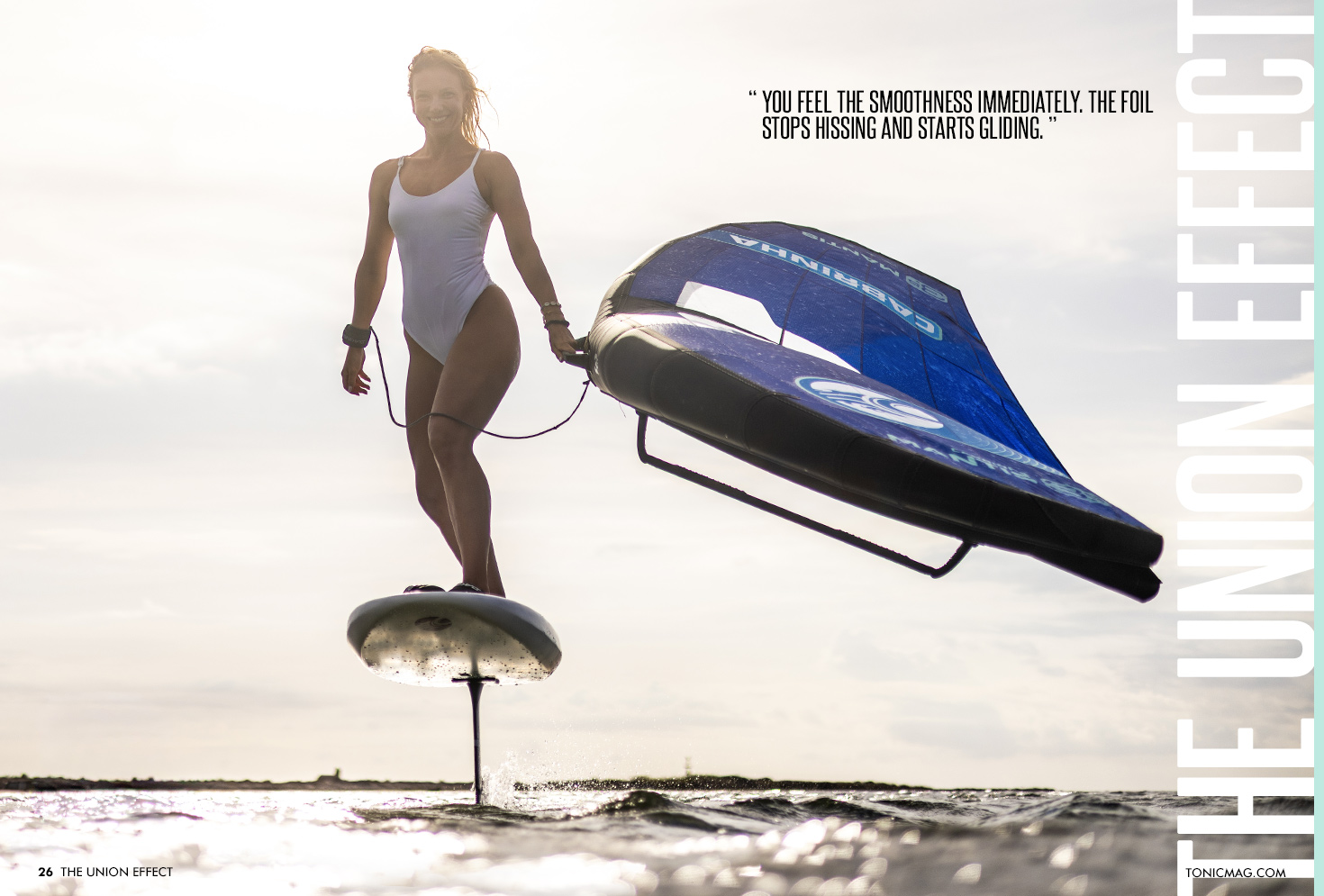
Riders describe it as “buttery”, but the engineering behind that sensation is a direct consequence of removing turbulence at the mast-to-fuselage interface. Water no longer fights the junction. Flow stays attached longer. The foil stops hissing and starts gliding. According to Modica, this isn’t subtle; you feel it immediately.
THE CASE FOR A MONOBLOCK TAIL
At the rear, Cabrinha made a decision that surprised some riders: the Prestige foil lineup launches exclusively with a monoblock tail. In a community where many love tuning shims or trimming stabilisers by half-degrees, committing to a fixed-angle tail is almost rebellious. But Cabrinha believed simplicity was a performance benefit, not a limitation.
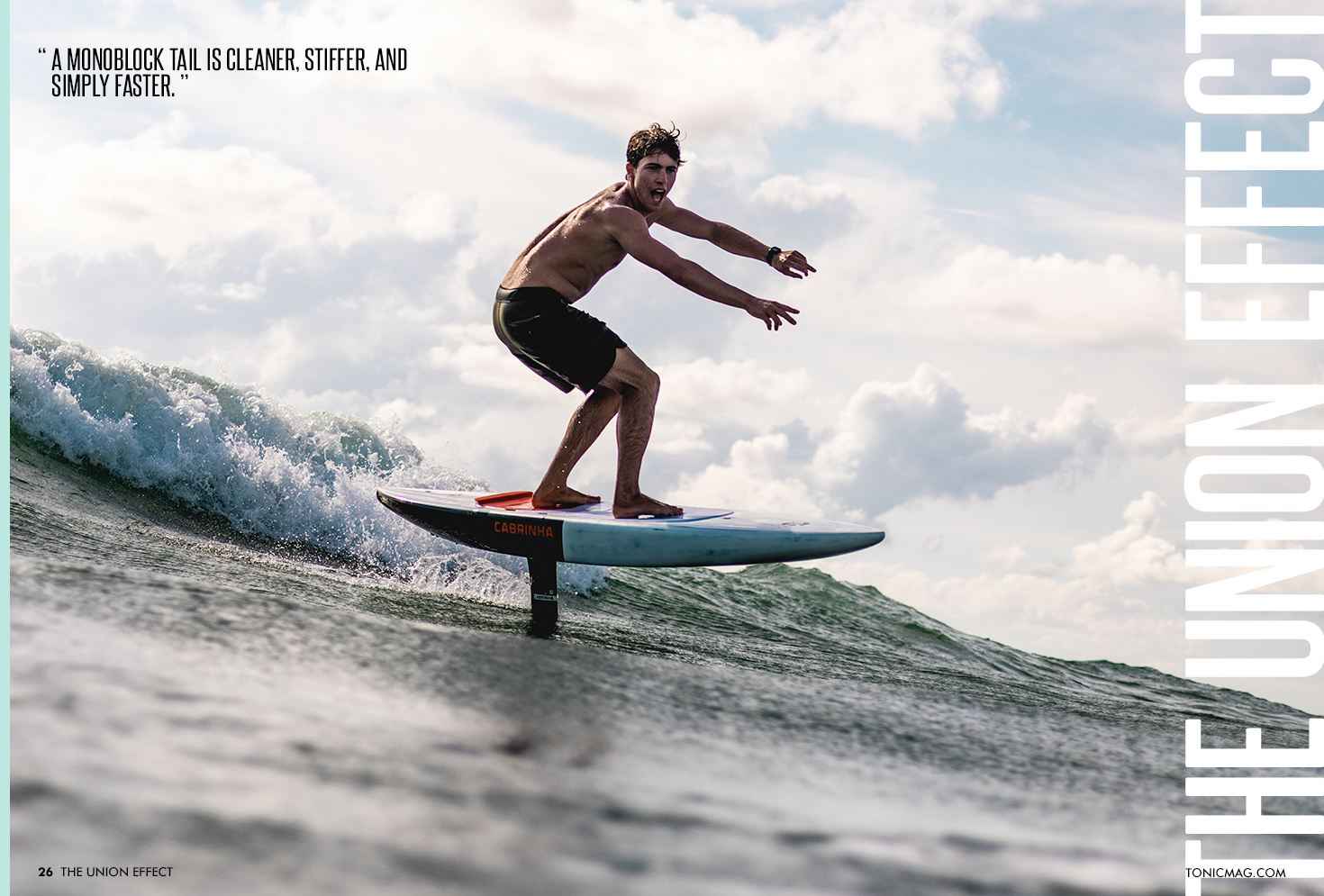
A monoblock tail is lighter, stiffer, and cleaner in the water. There are no shims, no secondary tolerances, and no bolt interference interrupting flow. The stabiliser angle is dialled in at the factory and matched to each front wing size, producing a foil that feels balanced out of the box. For most riders, this is exactly what they want. For those who love to tinker, Cabrinha already has an adjustable version underway, which will be launched soon.
Right now, though, the brand wanted purity: the cleanest, simplest, stiffest tail they could build. And the effect is unmistakable. The Prestige wings pump cleaner, recover faster, and carve more predictably because nothing at the tail is generating unwanted drag.
THE PRESTIGE WINGS: GLIDE WITHOUT COMPROMISE
Once the connection was locked in, hydrodynamic designer Brody Sutherland shaped the new wing lineup. What emerged is a trio of wings with a shared personality: crisp, smooth, ridiculously efficient, yet surprisingly forgiving.
The aspect ratios are high — 10.9 on the 1150, 11 on the 905 and 12.38 on the 760 — but the wings don’t behave like the more intimidating high-aspect foils on the market. They lift early, glide effortlessly, carry speed with almost no rider input, and turn far looser than their spans suggest.
Modica says that’s because the Union system removed the handbrake. Most wing profiles have to compensate for drag at the connection; Cabrinha didn’t need to. With a clean interface, the wings could be designed for balance, not correction.
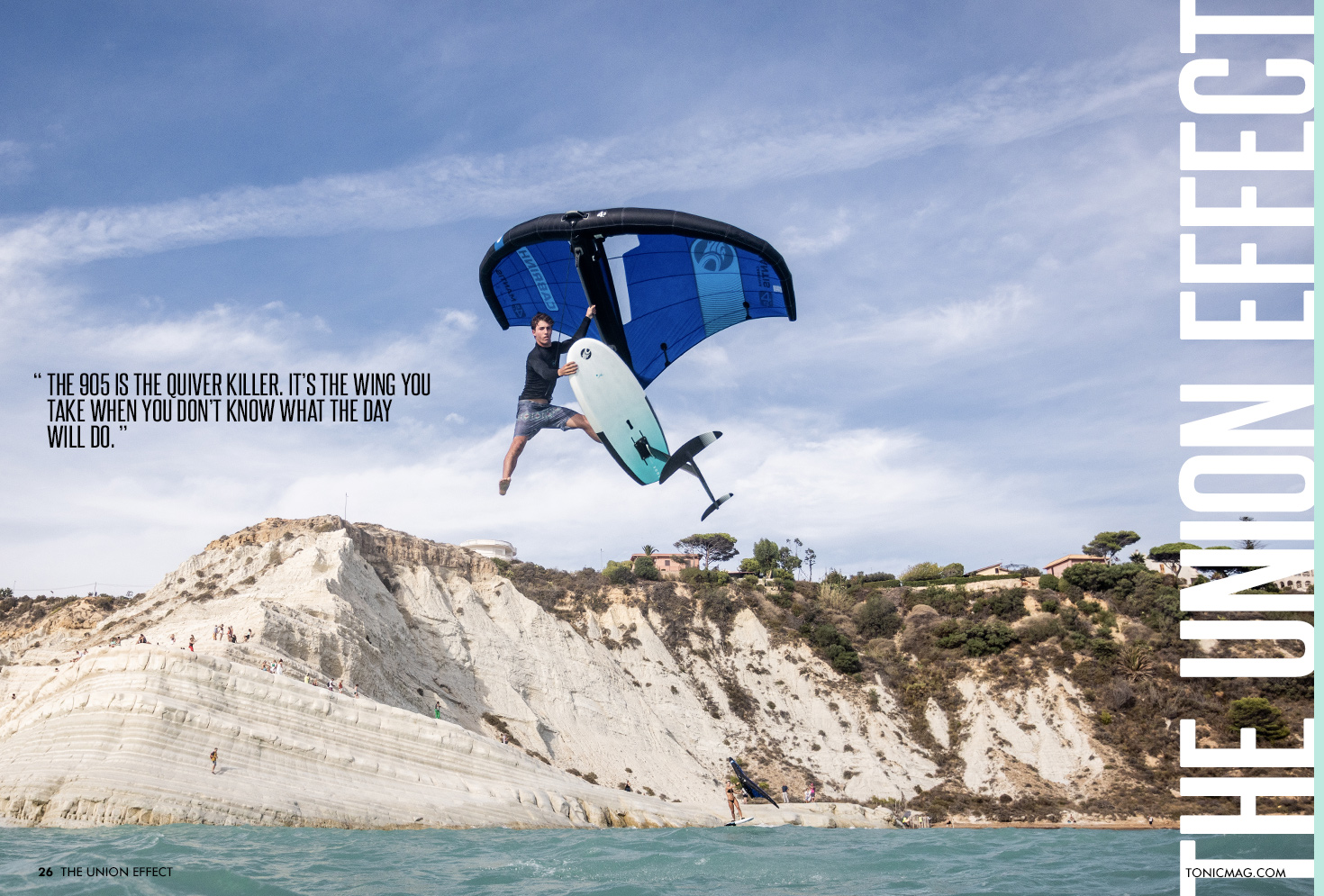
That’s why the 905 has already become the standout. Testers call it the “quiver killer”, the one wing you take when you don’t know what the day is doing. For prone, winging, and even downwind runs, it carries a huge range. At the top end is the 760, built for speed and control. At the other end is the 1150, which gets heavier riders flying early and keeps them gliding in marginal conditions. Together, the range covers most riders in just about any conditions — without being confusing.
DISTINCT SIZES, CLEAR PURPOSES
Unlike most brands, Cabrinha didn’t release eight front wings with small gaps between them, leaving you agonising over the 900 or 950, for example. They released three because three was enough. The 1150, 905 and 760 are all meaningfully different, each designed to own its category rather than overlap awkwardly with neighbouring sizes. It’s a rare moment of clarity in a market that often leaves even seasoned foilers struggling to decide on the right setup.
THE MASTS: ENGINEERING HONESTY
Supporting the wings are Cabrinha’s two mast options: a 16 mm high-modulus carbon mast and a 14 mm Apex version made with ultra-high-modulus fibres. Both masts are built to offer exceptional stiffness and glide. The goal was to keep thickness to a minimum while still offering enough stiffness to give riders total control in the most challenging conditions.
Cabrinha also resisted the temptation to offer five or six mast lengths. After talking with retailers and riders, they learned most foilers dislike owning multiple masts. So they built around the two lengths they felt would suit most of the market — 78 cm and 84 cm — again keeping things simple and making the purchasing choice easier.
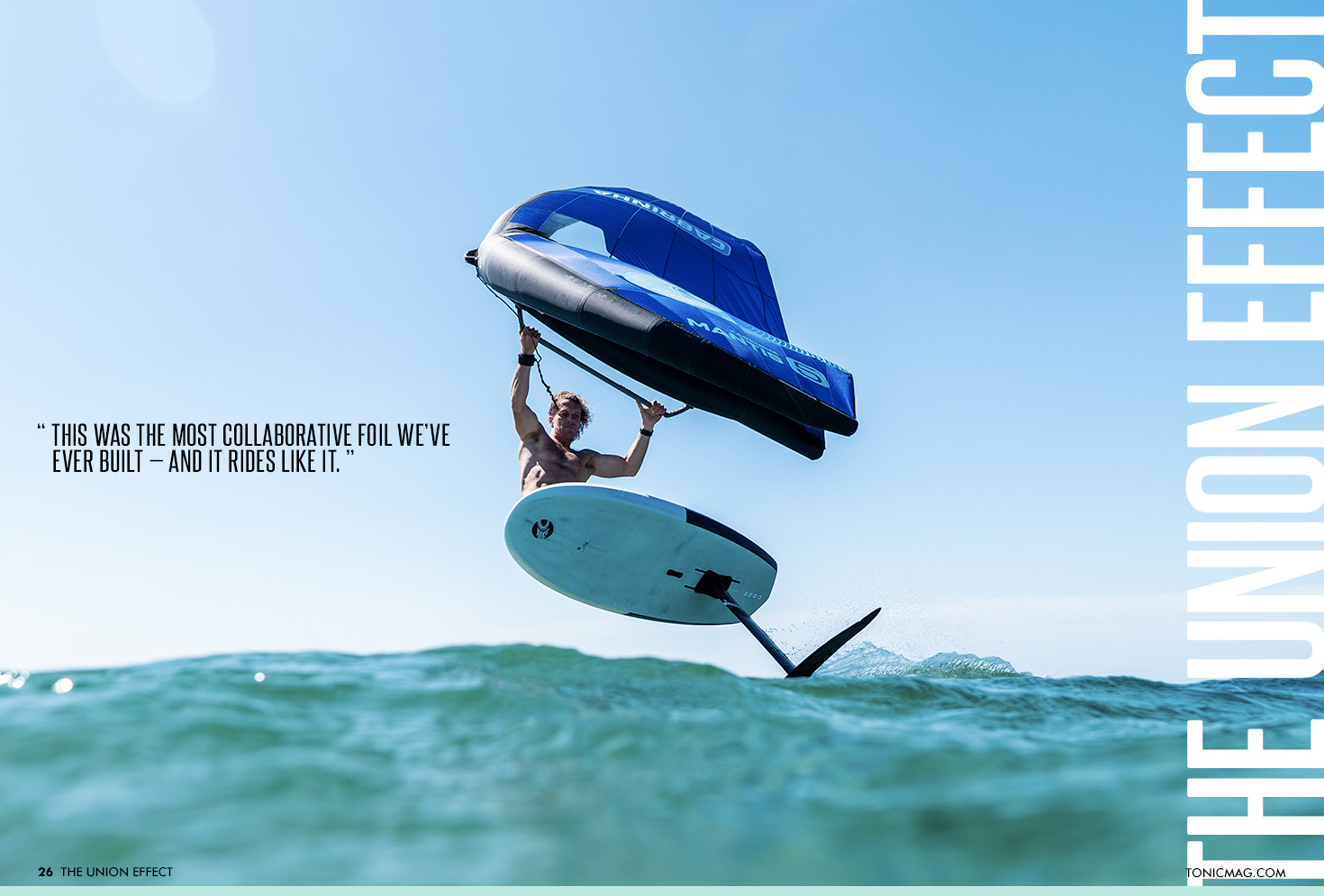
The 78 cm mast is the all-rounder, perfect for prone, surf, downwind, and flatter-water winging. The 84 cm mast is for high wind and chop, giving riders extra leverage and margin when the water gets messy. It’s the mast to go for if you mostly wing. Cabrinha felt anything shorter or longer serves only a niche, so they kept the range focused and functional.
A COLLABORATIVE FOIL WITH A COHESIVE FEEL
Unlike Cabrinha’s wings and kites — which are the singular vision of Pat Goodman — the Union system is the product of many minds: Brody shaping profiles, Mike and Stefano refining the connection, Lars Moltrup and his team managing construction and tolerances, team riders feeding daily insight, and Modica steering the ship.
The result of that shared engineering effort is a foil that feels incredibly polished. The Union doesn’t feel modular; it doesn’t feel like a collection of parts bolted together. It feels engineered as one continuous shape, translating energy cleanly from foil to mast to rider. It glides through the water with a silky feel that offers huge performance in an easy-to-ride package that will excite just about anyone who steps on it.
Modica distils the project down to one goal:
“Give people a foil that works unbelievably well without needing to tinker.”
And with the Union System, Cabrinha may have built exactly that.
Videos


By Tonic Mag
